


Many managers picture an ERP project like a construction job: the system is installed, the keys are handed over, the work is done. In practice an ERP is more like a living organism. The company grows, a new branch opens, regulations change, new people join, and the system has to adapt to all of it. So one of the most important questions when choosing a partner is: what happens after go-live?
This question matters especially for business in Tajikistan. On the President's initiative 2025–2030 were declared the Years of Digital Economy and Innovation Development, and according to the World Bank the economy grew 8.2% in the first half of 2026. In a fast-growing company an ERP is not something you configure once: it has to grow with the business.
Why many ERP projects fall short
Gartner predicts that by 2027 more than 70% of ERP initiatives will not fully meet their goals. The causes are usually not in the technology but in the period after implementation:
- staff never fully adopt the system and drift back to old Excel sheets;
- new hires are not trained by anyone;
- the business changes but the settings stay the same;
- nobody knows whom to ask when a question comes up;
- new versions and features go unused.
In other words, installing the system is half the job. The other half is keeping it working every day.
89% retention: what the number means
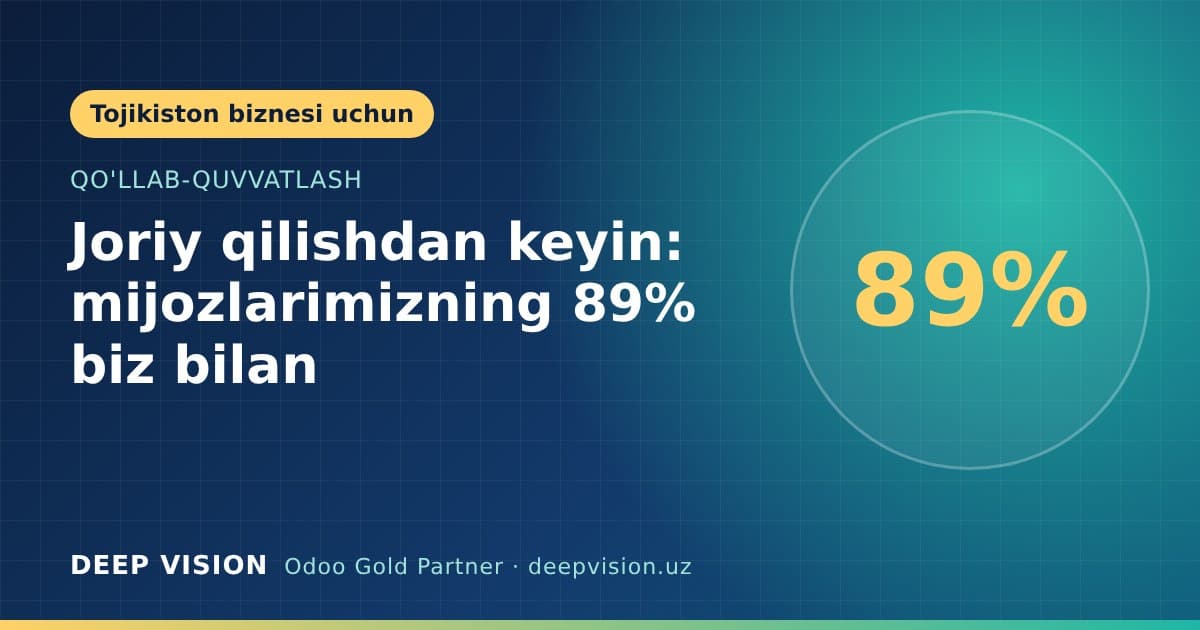
Odoo rates its partners by tier. Under the official requirements, the Gold tier needs a client retention rate of at least 80%. At Deep Vision this rate is 89%.
Retention means clients continue their Odoo subscription and keep working with the partner. The number is not marketing: Odoo uses it to set a partner's tier. If clients are unhappy with the system or the partner, they leave and the rate drops.
Per odoo.com/partners (November 2026), Deep Vision is the only Gold-tier Odoo partner in Central Asia.
What happens after go-live
The first months: stabilisation
The first weeks after launch are the most important. Staff start working with real data and questions multiply. In this period the Deep Vision team:
- answers users' questions;
- fixes issues that show up in real work;
- adjusts settings to practical needs;
- checks that reports come out correctly.
Training new staff
As a company grows, new people arrive. Training them is the simplest way to keep the quality of system use. Deep Vision has deep education experience: it has run 4 hackathons, 3 seminars and an online course, and Odoo is taught at 3 universities to more than 300 students a year. Deep Vision also helps clients find Odoo-trained candidates through its education programmes.
Adapting to business changes
When a new branch, warehouse, product line or legal entity appears, the system expands. Because Odoo is modular, new modules are added step by step, with no need to rebuild the whole system.
Reporting and analysis
All Deep Vision Odoo clients get reporting on an IFRS basis, also adapted to national reporting requirements. Almost all our clients have Odoo AI connected: financial analysis, forecasts, sales and sales-call analysis, and chat-style reports on the owner's phone.
Version upgrades
Odoo releases a new major version every year, with new features, better performance and a friendlier interface. The partner's job is to plan the upgrade, migrate data safely and explain the changes to staff.
Uzbekistan's experience: being ready for change
In Uzbekistan e-invoicing has been mandatory since 2020, and IFRS reporting is required for large companies and banks. Over these years the rules were updated many times, and ERP systems had to change with them. Deep Vision worked through those changes: for example, it built ready Odoo modules for Didox (e-invoicing) and Asl Belgisi (digital marking).
These modules are for Uzbekistan's systems. But the experience itself matters: adapting an ERP quickly when rules change. Tajikistan's digital tax and reporting systems are developing too, and companies need a partner that adapts to change alongside them.
Example: a distributor in Khujand
The scenario below is illustrative, not real client figures. A distributor in Khujand with 60 staff launched Odoo: sales, inventory, purchasing and accounting.
- Months 1–2. Sales agents switch to mobile orders, warehouse staff work with barcodes. There are many questions, and the team answers them quickly.
- Months 3–6. The company opens a second warehouse in Dushanbe. The new warehouse and routes are added to the system, with no re-implementation.
- Months 6–12. New agents and an accountant join and are trained. The owner gets sales and receivables reports on the phone through Odoo AI.
- Next year. A move to the new Odoo version is planned.
This way the system stays not a one-off project but a tool that grows with the business.
What to ask a partner
- How is support organised after go-live?
- Who trains new staff?
- How are version upgrades planned?
- What is your retention rate, and who confirms it?
- Can we talk to your existing clients?
Deep Vision says yes to the last question too: with clients' consent, reference calls with existing clients are arranged. Projects in Central Asia are run in Russian.
More: 15 reasons for Tajik business, Step-by-step implementation. To talk, leave a request.
Frequently asked questions
Do we need a partner after Odoo goes live?
Yes. The system changes with the business: new staff, branches, reports and versions. A partner helps do this in a planned way.
What does 89% retention mean?
It is the share of Deep Vision clients who keep working with Odoo and with us. Odoo requires at least 80% for the Gold tier.
Do you help train new staff?
Yes. We also help find Odoo-trained candidates through our education programmes.
Is moving to a new Odoo version hard?
Odoo releases a new version every year. The move is planned, data is checked and changes are explained to staff.
What language do you work in with a company in Tajikistan?
Projects in Central Asia are run in Russian.
Sources
- Odoo: partner tier requirements (odoo.com/become-a-partner)
- Odoo partner directory: odoo.com/partners (November 2026)
- Gartner: ERP initiatives prediction (2027)
- World Bank, Tajikistan Economic Update, 2026
- Khovar: 2025–2030 Years of Digital Economy and Innovation Development
- Deep Vision: internal data (89% client retention)