


Short answer: Industry 4.0 (the fourth industrial revolution) is a way of running production in which machines, warehouses, software and people are connected into one digital system and share data in real time. It rests on the industrial internet of things (IIoT), cloud computing, data analytics, AI, and ERP and MES systems. For a manufacturer in Uzbekistan, Industry 4.0 does not start with robots: it starts with bringing orders, inventory, production and finance into one ERP system, and sensors and predictive analytics are added on top of that foundation.
Many manufacturers hear "Industry 4.0" and think: "Another foreign IT trend, nothing to do with us." In reality it is about your shop floor, your lines and your warehouse. The picture is familiar: the director walks the workshops asking how many units were made, a machine breaks down and the day's plan falls apart, and the real product cost only appears at month end. The root cause: what happens in the plant is not visible in time.
Industry 4.0 answers that blind spot. Below: the technologies, the roles of ERP, MES and IoT, what it means in Uzbekistan, and where to start.
What is Industry 4.0?
Industry 4.0 is the stage of manufacturing in which physical operations (machines, lines, stock) and digital systems (ERP, MES, analytics) work as one, and decisions are made on real-time data.
Put simply, the machines, systems and people in your plant can "talk" to each other.
Before, a lathe cut parts but did not "tell" anyone how many, when it might fail or how much power it used. With Industry 4.0:
- Every machine, line and even warehouse item "speaks" through sensors. Equipment reports when it is running, when it has stopped and when it needs repair.
- All data flows into one place: the ERP system or the cloud. The director no longer walks to the shop floor to ask how many units are finished; the answer is on the phone.
- Analytics and AI warn you in advance. For example: "This machine may fail in 2 weeks, order the spare part now" or "Demand for this product will rise 20% next month, stock up on raw materials."
The term comes from Germany: "Industrie 4.0" was presented at the Hannover Messe trade fair in 2011 as part of the German government's high-tech strategy. In 2016 Klaus Schwab, founder of the World Economic Forum, published "The Fourth Industrial Revolution" and took the idea global.
Industry 4.0 is digitalization applied to manufacturing; the terms are compared in What is digitalization and why it is vital for business.
What came before Industry 4.0?
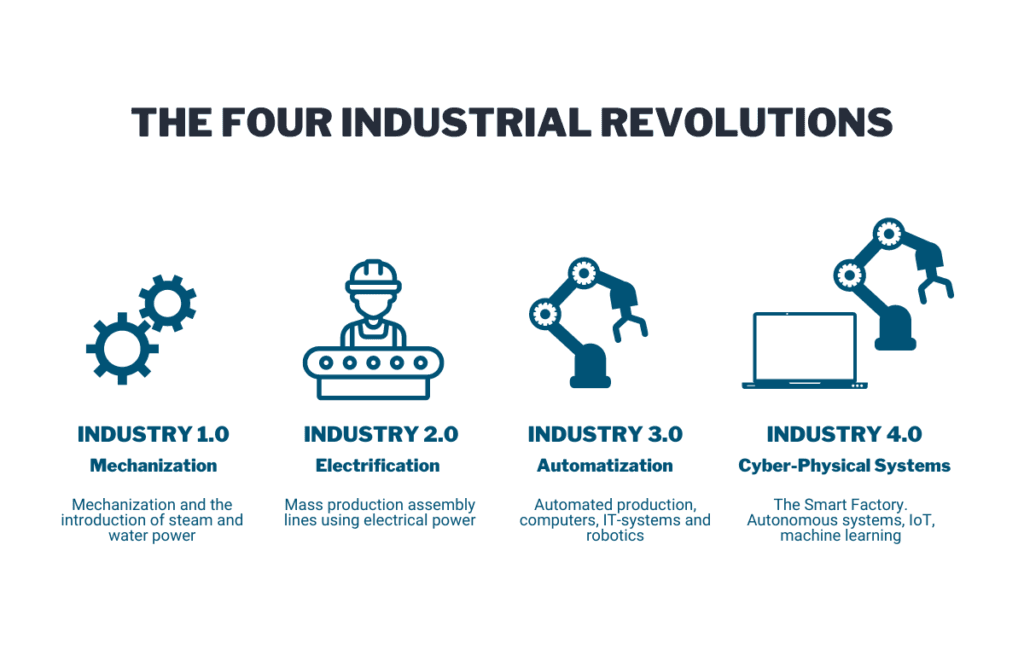
Manufacturing has been transformed four times: by steam, electricity, computers and now data.
- Industry 1.0: steam (around the 1780s). Steam engines replaced human and animal power, and textile mills replaced hand weaving.
- Industry 2.0: electricity and the assembly line (around the 1870s). Electric power arrived, followed by assembly lines like the one at Henry Ford's car plant. Mass production became fast and cheap.
- Industry 3.0: computers and automation (around the 1970s). Computers, programmable logic controllers (PLCs) and robots entered factories, and some processes began to run without people.
- Industry 4.0: connected, "smart" production (from the 2010s). Automated equipment is no longer an isolated island: it is networked, reports data and works together with management systems.
The essence of 4.0 is connection: turning machine data into decisions.
Which technologies does Industry 4.0 rely on?
Industry 4.0 is not one technology but a combination of several, all serving one goal: getting accurate production data on time and acting on it.
- Industrial IoT. Sensors measure temperature, pressure, vibration, current and output counts, so equipment reports its state in real time.
- Big data and analytics. Show which line stops most often and which shift produces the most defects.
- AI and machine learning. Forecast failures, demand shifts and quality drift; camera-based visual inspection belongs here too.
- Cloud computing. Data is available on a phone or tablet, without your own server room.
- Digital twins, cobots and 3D printing. Test changes on a digital model, automate repetitive tasks, print spare parts.
- ERP and MES. Bring everything into one "control center" linked to orders, plans, stock, product cost and finance.
- Cybersecurity. Once machines are networked, protecting them becomes part of plant safety.
You do not need all of this at once: ERP, simple sensors and good reporting pay off first; digital twins and AI come later.
ERP, MES and IoT: who does what in Industry 4.0?
IoT collects data from equipment, MES runs the shop floor, and ERP runs the whole company, from the customer order to cash flow. Industry usually shows these layers as the "automation pyramid" based on the ISA-95 standard:
- Levels 0–1: machines, sensors and actuators. The physical process: temperature, pressure, speed, unit counts.
- Level 2: control (PLCs, SCADA, operator panels). Controls equipment in seconds and milliseconds.
- Level 3: MES (Manufacturing Execution System). Shifts and work orders: which order runs on which machine, how long it took, how much scrap.
- Level 4: ERP. Days, weeks and months: sales orders, production plan, purchasing, stock, product cost, accounting and tax.
In short, IoT and SCADA answer "what is the machine doing now?", MES answers "how is today's plan going?", and ERP answers "what should we make, when, and what did it cost and earn?"
A small or mid-sized manufacturer rarely needs a separate, expensive MES. The manufacturing modules of modern ERP systems (Odoo Manufacturing, for example) cover the core MES functions: work orders, shop floor tablets, operation time tracking and quality checks. For ERP basics, read What is an ERP system?
A practical rule: do not send every sensor reading to the ERP every second. Aggregate first ("42 minutes of downtime this shift, 2,350 units produced") and pass only those figures to the ERP.
What does Industry 4.0 mean for manufacturers in Uzbekistan?
For a manufacturer in Uzbekistan, Industry 4.0 is not a robot-run factory but the ability to see and control raw materials, equipment, people and money in real time.
Many assume it is "for big plants in Germany and Japan". In fact, smaller producers often see results faster: every idle machine hurts them more.
Typical situations in food and beverage, textile, building materials, furniture, plastics and packaging plants:
- Raw materials run out unexpectedly. The storekeeper logs stock in a notebook and learns of a shortage when the line stops. A digital system raises a warning or purchase request once stock falls below the minimum.
- Nobody knows when a machine will fail. Tracking running hours, vibration and temperature lets you schedule maintenance before a stop wrecks the plan.
- The director cannot be everywhere. An owner with three workshops cannot watch them all; one screen showing every workshop saves time and nerves.
- Product cost is known too late. Prices are set by estimate; the real cost appears at month end, or never.
- Energy costs. Electricity and gas are getting more expensive, yet few plants know how much each line consumes.
Local requirements push digitalization too:
- Digital marking (Asl Belgisi). Producers of beverages, medicines and a number of other product groups must apply marking codes and track their movement, which is hard without batch tracking. See our guide to Asl Belgisi digital marking.
- Electronic invoices. Invoices reach the Soliq (tax) system through operators such as Didox; generating them from the ERP removes re-entry.
- Scattered systems. Accounting often runs in 1C, planning in Excel and the shop floor on paper. When data lives in three places, none of it can be fully trusted.
The state backs this through the "Digital Uzbekistan 2030" strategy, but the main driver is the market: competition, quality and lead-time demands, export traceability.
What does Industry 4.0 deliver in practice?
In practice Industry 4.0 means less downtime, fewer defects, less excess stock and faster decisions based on numbers.
- Less downtime. Stop reasons are recorded and the costliest fixed first.
- Predictive maintenance. Repairs are planned when readings drift, not after a breakdown.
- Quality control. Defect causes are visible by batch, shift and machine.
- Leaner inventory. Materials are bought against plan and actual use, so "just in case" stock shrinks.
- Accurate product cost. Materials, labor and machine hours are costed per order.
- Traceability. You see which raw material batch went into which product and who bought it.
To measure the effect, industry widely uses OEE (Overall Equipment Effectiveness). It multiplies availability (share of planned time the machine ran), performance (speed against the standard rate) and quality (share of good output). Measure it at the start of a project.
Where should you start with Industry 4.0?
You do not need to leap into Industry 4.0: first bring processes into one system, then make the data visible, and only then move to sensors and automation. Sensors and AI cannot be bolted onto a company running on paper; the foundation comes first.
The Industrie 4.0 Maturity Index from acatech (the German National Academy of Science and Engineering) describes six stages: computerization, connectivity, visibility, transparency, predictive capacity and adaptability. A plant on paper and Excel has not completed even the first. A practical path:
- Assess where you are. Paper, Excel, 1C or several programs? Where is the biggest loss: downtime, defects, shortages or late orders?
- Bring processes into one ERP. Sales, purchasing, inventory, production and finance in one system (Odoo, for example) are your digital foundation. Bills of materials (BoM) or recipes, routings and work centers are digitized here.
- Make the shop floor visible. Operators run work orders on a tablet, record stops and scrap, and materials are consumed by barcode.
- Pilot at one bottleneck. Take the line with the most downtime or your most expensive machine, fit simple sensors (running/stopped signal, unit counter, electricity meter) and track OEE for 2–3 months.
- Integrate. Aggregated sensor and PLC data flows into the ERP: counts into work orders, downtime into maintenance, energy into cost. Critical alerts can go to the foreman on Telegram.
- Scale and add analytics. If the pilot pays off, roll it out to other lines; once history builds up, add predictive maintenance and demand forecasting.
For a general automation roadmap, see Business process automation: where to start.
What mistakes are common in Industry 4.0 projects?
The most expensive mistake is buying technology before the processes are in order. Others:
- "Sensors first". Data is collected, but nobody decided who uses it for which decision. The result: attractive, useless charts.
- Messy master data. Wrong product records, recipes or units of measure mean wrong costs in any system.
- Forgetting people. If operators do not see why the system exists, work carries on "on paper".
- Ignoring cybersecurity. If the production network is not separated from the office network, one piece of malware can stop a line.
- Closed systems. Equipment without open interfaces (OPC UA, MQTT, APIs) is costly to connect later.
Industry 4.0 readiness checklist
The more items you can tick, the readier you are:
- Main products have documented recipes or bills of materials and routings.
- Stock is kept in a system and regularly reconciled with physical counts.
- Stop reasons and scrap are recorded at least daily.
- The 1–2 bottlenecks causing the biggest losses are identified.
- The pilot has a budget, timeline and measurable target (OEE or downtime, for example).
How can Odoo and Deep Vision help?
Odoo can serve as the "ERP layer" of Industry 4.0: it combines sales, purchasing, inventory, manufacturing, quality, maintenance and finance in one database.
The main Odoo apps for manufacturing:
- Manufacturing (MRP): bills of materials, work centers, work orders, planning and product cost.
- Shop Floor: tablet screens where operators run work orders and log time and scrap.
- Inventory: lots and serial numbers, expiry dates, barcodes, reordering rules.
- Quality and Maintenance: quality control points, preventive and corrective maintenance.
- IoT: the Odoo IoT Box connects scales, scanners, cameras, measuring tools and printers to Odoo.
- Purchase and Accounting: planned purchasing, product cost and financial reports.
Some apps (Quality, IoT and shop floor tablets, for example) exist only in the Enterprise edition; see Odoo Community vs Enterprise. Module details: Odoo Manufacturing; industry view: Odoo ERP for manufacturing companies.
Deep Vision is an official Odoo Gold Partner, with 7 certified specialists and 26 client projects listed in the odoo.com partner directory. Our job is to help you run everything from the warehouse to production in one system, accurately and under control. We have ready-made Odoo modules for Asl Belgisi marking and Didox e-invoicing. A full project usually takes 2–6 months; standard Sales and Inventory modules often go live in 6–8 weeks.
To be straightforward: machine-level automation (PLCs, SCADA, sensors) is usually done with the equipment supplier or automation engineers; the ERP team builds the foundation and designs which shop floor data enters the system. To find your first step, fill in a short brief or read about our Odoo implementation service.
Frequently asked questions
Does a small manufacturer need Industry 4.0?
Yes, but not as robots and AI. For a small plant it starts with seeing orders, stock, production and finance in one system, then fitting a simple sensor to the most troublesome machine.
How much does moving to Industry 4.0 cost?
There is no single price: it depends on the number of lines, equipment readiness, modules, integrations and training. The cheapest route is step by step: ERP, a pilot on one line, then scaling.
Can old machines be connected?
Usually, yes. Without a network interface, key figures can still be captured with external sensors (current, unit counter, running/stopped signal) and small controllers, far cheaper than replacing the machine.
Do we need a separate MES, or is ERP enough?
For small and mid-sized plants the ERP manufacturing module is usually enough. High-speed continuous processes (chemicals, for example) may need a dedicated MES or SCADA integrated with the ERP.
What is Industry 5.0?
A concept the European Commission put forward in 2021. It does not replace Industry 4.0 but adds a focus on people, sustainability and resilience. For most companies in Uzbekistan the task now is building the Industry 4.0 foundation.
When will we see the first results?
Standard Sales and Inventory modules often go live in 6–8 weeks; a full project including manufacturing usually takes 2–6 months. Real-time stock levels and order status are visible as soon as the ERP goes live.
Conclusion
Industry 4.0 is not the future; it is already here. For a manufacturer in Uzbekistan the question is no longer "do we need it?" but "when and how do we start?". If you are not sure where to begin, book a free consultation or call +998 77 093 00 07. We will review your processes and agree on the first step together.