


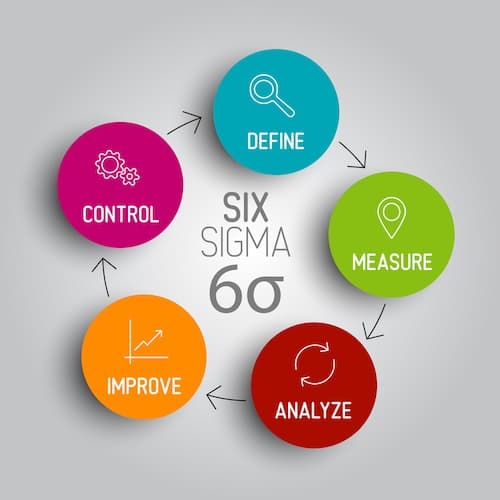
Short answer: Six Sigma is a data-driven quality management methodology that uses statistics to reduce process variation and defects. A six sigma process produces no more than 3.4 defects per million opportunities. You implement it through DMAIC projects (Define, Measure, Analyze, Improve, Control), starting with one measurable problem. You don't need expensive software to begin, just reliable data and a small trained team; an ERP system collects that data automatically.
In any factory you hear "scrap", "rework" and "customer complaint" every day. At month end the director asks why defects went up, and the answers are guesses: "the workers were tired", "the material was bad". Defects are counted in a notebook or in Excel, photos of faulty parts sit in the shop's Telegram group, and rework time and material go unrecorded. The same mistakes repeat month after month.
What is Six Sigma?
Six Sigma is a data-driven improvement methodology that minimizes defects by measuring and reducing process variation.
In statistics, sigma (σ) is the standard deviation: how widely results spread around the average. If a 600 mm part comes out at 599 mm one day and 603 mm the next while the customer accepts only ±1 mm, part of that spread becomes scrap.
A six sigma process produces only 3.4 defects per million opportunities. Put simply, Six Sigma replaces "I think" with numbers: it shows at which step, how often and why defects occur. It rests on three ideas:
- The customer defines quality, so you measure what is critical to them (CTQ, Critical to Quality).
- Defects come from variation: reduce the spread and defects fall.
- Decisions rest on data, not opinions or job titles.
Where did Six Sigma come from?
Six Sigma took shape at Motorola in 1986. Its roots go back to the late 1970s, when the company admitted its quality lagged behind Japanese competitors. Engineer Bill Smith proposed reducing defects systematically with statistics, and the approach spread across the company.
General Electric made it famous: in the mid-1990s, under Jack Welch, GE rolled out Six Sigma company-wide and reported savings in the billions of dollars. Thousands of manufacturers and service companies followed.
Sigma levels: where does your process stand?
A sigma level is a single number that shows how reliably a process meets customer requirements. It is calculated from DPMO (defects per million opportunities). The standard scale, including the long-term 1.5 sigma shift:
- 2 sigma: 308,537 DPMO, about 69% defect-free.
- 3 sigma: 66,807 DPMO, about 93.3%.
- 4 sigma: 6,210 DPMO, about 99.38%.
- 5 sigma: 233 DPMO, about 99.977%.
- 6 sigma: 3.4 DPMO, 99.99966%.
Most companies that start measuring sit between 3 and 4 sigma; moving from 3 to 4 cuts defects roughly tenfold. In furniture, 4–5 sigma is already very good.
What is DMAIC and how does it work?
DMAIC is the five-phase cycle for running Six Sigma projects: Define, Measure, Analyze, Improve, Control. Each phase answers one question and ends with a result.
1. Define: which problem are we solving?
State the problem in one sentence with a number: "Lacquer defects have pushed rework of kitchen fronts to 120 a month." Write a project charter (goal, scope, team, timeline, benefit), map the process with SIPOC (Suppliers, Inputs, Process, Outputs, Customers) and set CTQs from the voice of the customer.
2. Measure: what does the current state look like?
Calculate current DPMO, first pass yield (FPY), cycle time and the cost of poor quality. First check the measurement system (MSA or Gage R&R): if two inspectors judge the same part differently, the data can't be trusted. A written defect definition with reference photos is a good start.
3. Analyze: where and why do defects happen?
Slice the data by step, shift, machine, batch and supplier. A Pareto chart shows the main defect types, an Ishikawa (fishbone) diagram groups causes (people, machines, methods, materials, measurement, environment), and the 5 Whys lead to the root cause. Test every hypothesis against data.
4. Improve: what do we change?
Address only proven root causes. The best fixes make errors physically impossible (poka-yoke), like a jig that won't accept a part the wrong way round. Pilot the change, measure the effect, then roll it out.
5. Control: how do we keep the gain?
Put the new method into a standard operating procedure (SOP), write a control plan, track the key metric on a control chart (SPC) and hand over to the process owner. Skip this and the process slides back within months.
Six Sigma belts: who does what?
Belts are titles borrowed from martial arts that show a person's Six Sigma training level and project role. They are awarded to individuals, not companies.
- Champion (sponsor): a senior manager who picks projects, funds them and removes barriers.
- Master Black Belt: trains and coaches Black Belts and owns the program's methodology.
- Black Belt: leads complex projects full time and does in-depth statistical analysis.
- Green Belt: leads smaller projects alongside a regular job; often a process engineer, shop supervisor or quality engineer.
- Yellow and White Belts: know the basics and help collect data and test solutions.
A mid-sized company can start with one or two Green Belts, a sponsor and an external coach. Certificates come from various bodies; there is no single official authority.
Which tools does Six Sigma use?
Six Sigma tools are standard methods for collecting data, analyzing it and locking in results across the DMAIC phases. You don't need them all at once:
- Define: SIPOC, process map, CTQ tree (turns "a good front" into criteria like size ±1 mm, no bubbles).
- Measure: check sheet, MSA, histogram.
- Analyze: Pareto, Ishikawa, 5 Whys; regression and design of experiments (DOE) in complex projects.
- Improve: poka-yoke, pilots, FMEA (assessing risks in advance).
- Control: control charts (SPC), SOPs, control plan.
Which metrics does Six Sigma rely on?
Six Sigma metrics measure process quality, speed and the cost of poor quality; together they show where to focus. Counting "pieces scrapped" is not enough:
- DPMO (Defects Per Million Opportunities): the heart of Six Sigma. Formula: defects ÷ (units × defect opportunities per unit) × 1,000,000.
- First Pass Yield (FPY): the share of units right the first time, without rework. Multiplied across steps it gives RTY (Rolled Throughput Yield): three steps at 95% give about 86%.
- Cycle Time: how long one unit takes from start to finish.
- Process Capability (Cp, Cpk): how well the process fits the customer's tolerances; a Cpk of 1.33 or higher is generally considered capable.
- COPQ (Cost of Poor Quality): scrap, rework, returns, warranty repairs and lost customers. These costs rarely appear as a separate line in the accounts, hence the name "the hidden factory".
For a director, the clearest metric is COPQ in Uzbek sum; see our management accounting guide and the article on cutting costs through automation.
Worked example: a DMAIC project in a furniture workshop
The numbers are illustrative; they show how the calculation works.
Define. A workshop makes 2,000 kitchen fronts a month, each with four defect opportunities: cut size, edge banding, drilling and lacquer finish. Final inspection and complaints record 120 defects a month. Goal: cut them by more than half in three months.
Measure. DPMO = 120 ÷ (2,000 × 4) × 1,000,000 = 15,000, roughly 3.7 sigma. 110 fronts had at least one defect, so FPY = (2,000 − 110) ÷ 2,000 = 94.5%. If reworking one front costs 80,000 sum, COPQ = 120 × 80,000 = 9.6 million sum a month.
Analyze. Pareto: lacquer 66 (55%), edge banding 30 (25%), cutting 16, drilling 8. Two types cause 80% of defects, so the team starts with lacquer. A breakdown by shift and order type shows lacquer defects jump when drying time is cut on rush orders and on humid days in the spray booth.
Improve. A minimum drying time becomes a mandatory work order step; humidity is checked before spraying, and spraying doesn't start above the limit. Rush orders now include drying time. The fix is piloted on one line for two weeks.
Control. A quality control point is added at the lacquer step, with a weekly Pareto chart and a daily control chart. If defects fall to 50 the next month: DPMO = 50 ÷ 8,000 × 1,000,000 = 6,250, about 4 sigma. COPQ = 50 × 80,000 = 4 million sum, saving 5.6 million sum a month.
The lesson: reliable records and one disciplined change mattered more than advanced statistics.
Six Sigma vs Lean vs Kaizen: what is the difference?
Kaizen, Lean and Six Sigma are not rivals; they approach process improvement from different angles.
- Kaizen is a Japanese philosophy of "small, continuous improvements": every employee suggests small changes daily. It is more culture than method.
- Lean grew out of the Toyota Production System and targets waste (excess stock, waiting, unnecessary movement) and flow speed.
- Six Sigma is statistical: it proves the problem with numbers and solves it through DMAIC, focusing on variation and defects.
Combined, they are called Lean Six Sigma: Kaizen brings small daily improvements, while Six Sigma solves big systemic problems with data. If a cause is obvious, just fix it without DMAIC.
How do you implement Six Sigma in a company?
Implementing Six Sigma means completing one DMAIC project on one measurable problem, then scaling what worked, not changing the whole company at once. A sequence for a mid-sized company:
- Appoint a sponsor who publicly commits time and resources.
- List quality problems (scrap, rework, complaints, late orders) with a rough sum figure for each.
- Pick the first project: recurring, measurable, cause unknown, solvable in 3–6 months.
- Train the team: one or two Green Belts, participants to Yellow Belt.
- Fix data collection: agree defect types and reference photos; data goes into one system, not notebooks, Excel and Telegram chats.
- Measure the baseline for at least 3–4 weeks: DPMO, FPY, COPQ.
- Work through DMAIC with a short sponsor review after each phase.
- Pilot the solution on one line or shift.
- Standardize: SOPs, a control plan, control points in the ERP.
- Announce the result in sum and pick the next project.
It works outside the factory too: an e-invoice rejected in Didox over wrong details is also a "defect". See also where to start automating business processes.
How does ERP data support Six Sigma?
An ERP system is the data source for Six Sigma: it records defects, time and costs for every order, operation and batch automatically, so the team analyzes instead of collecting numbers. You don't need a costly dedicated "Six Sigma program"; in an ERP such as Odoo, most of this data is captured during everyday work:
- Manufacturing: planned vs actual time per manufacturing order and work order, work center load and downtime. Details: Odoo Manufacturing.
- Scrap records: what was scrapped, at which step, how much and why; scrap value is reflected in the books.
- Quality app: quality control points at receipt, a production operation or a work order step. Checks can be pass/fail, a measurement with tolerances or a photo, on every operation or a sample. A defect opens a quality alert with root cause and corrective and preventive actions.
- Lots and serial numbers: trace a defect back to the material batch and supplier.
- Reporting: pivot tables and graphs by step, shift, product or supplier. DPMO and FPY aren't standard reports, but the inputs are there, so they're configured as a report or dashboard.
One caveat: Odoo's Quality app is part of the Enterprise edition. Community has manufacturing, work orders and scrap, but quality control points need Enterprise or custom development (see Odoo Community vs Enterprise). On Odoo Enterprise, no separate Six Sigma software is needed, only proper configuration. On connecting machines to the ERP, see what Industry 4.0 is.
How can Deep Vision help?
Deep Vision is an official Odoo Gold Partner in Tashkent. We don't issue Six Sigma certificates or run DMAIC projects for you; we build the data system your team relies on.
We built these Six Sigma principles into our solution for furniture manufacturers, where scrap and rework are among the largest hidden costs: wrongly cut parts, poor lacquering, mismatched dimensions. In that solution:
- scrap and its cause are recorded for every furniture order;
- First Pass Yield is tracked per workshop;
- you see at which step (cutting, assembly, lacquering) most problems occur;
- the director decides where to focus based on numbers, not guesses.
Other industries follow the same order: map processes and defect types, then configure Odoo. For the industry view, read Odoo ERP for manufacturing companies; for our services, see Odoo implementation. Describe your quality problem in this form, and we'll work out together what data to collect and how.
Six Sigma starter checklist
- A sponsor is appointed and time is allocated.
- The 3–5 costliest quality problems have a sum figure.
- The first project is recurring, measurable and has an unknown cause.
- The problem and goal fit in one sentence with a number.
- Defect types and reference photos are approved; measurement is checked.
- Baseline DPMO, FPY and COPQ are calculated from data kept in one system.
- The root cause is confirmed with data.
- The fix is piloted, the SOP written, an ERP control point set up.
- The result is calculated in sum and shared with the team.
Frequently asked questions
Is Six Sigma only for large factories?
No. Its essence is simple: stop guessing and start measuring. A small workshop can run a DMAIC project on one problem too.
How long does a Six Sigma project take?
Usually 3–6 months. In small, tightly scoped projects first results appear in the pilot, within a few weeks.
Do we need to hire a Black Belt?
Not at first: one or two Green Belts and an external coach will do.
How is Six Sigma different from ISO 9001?
ISO 9001 is a quality management system standard that companies are certified against. Six Sigma is a problem-solving methodology, and belt certificates go to individuals. The two complement each other.
Does Six Sigma work in services?
Yes. In logistics, retail and call centers, a defect is a document error, a late delivery or a missed call. The DMAIC logic is the same.
Can Odoo show DPMO and FPY?
Not as standard reports, but the inputs (output, scrap, quality check results) are in the system, and a report or dashboard is built on them.
Next step
Want to know what scrap and rework really cost you? Start by getting the data into one system. Book a free consultation or call +998 77 093 00 07, and the Deep Vision team will show how to collect Six Sigma data in Odoo.