


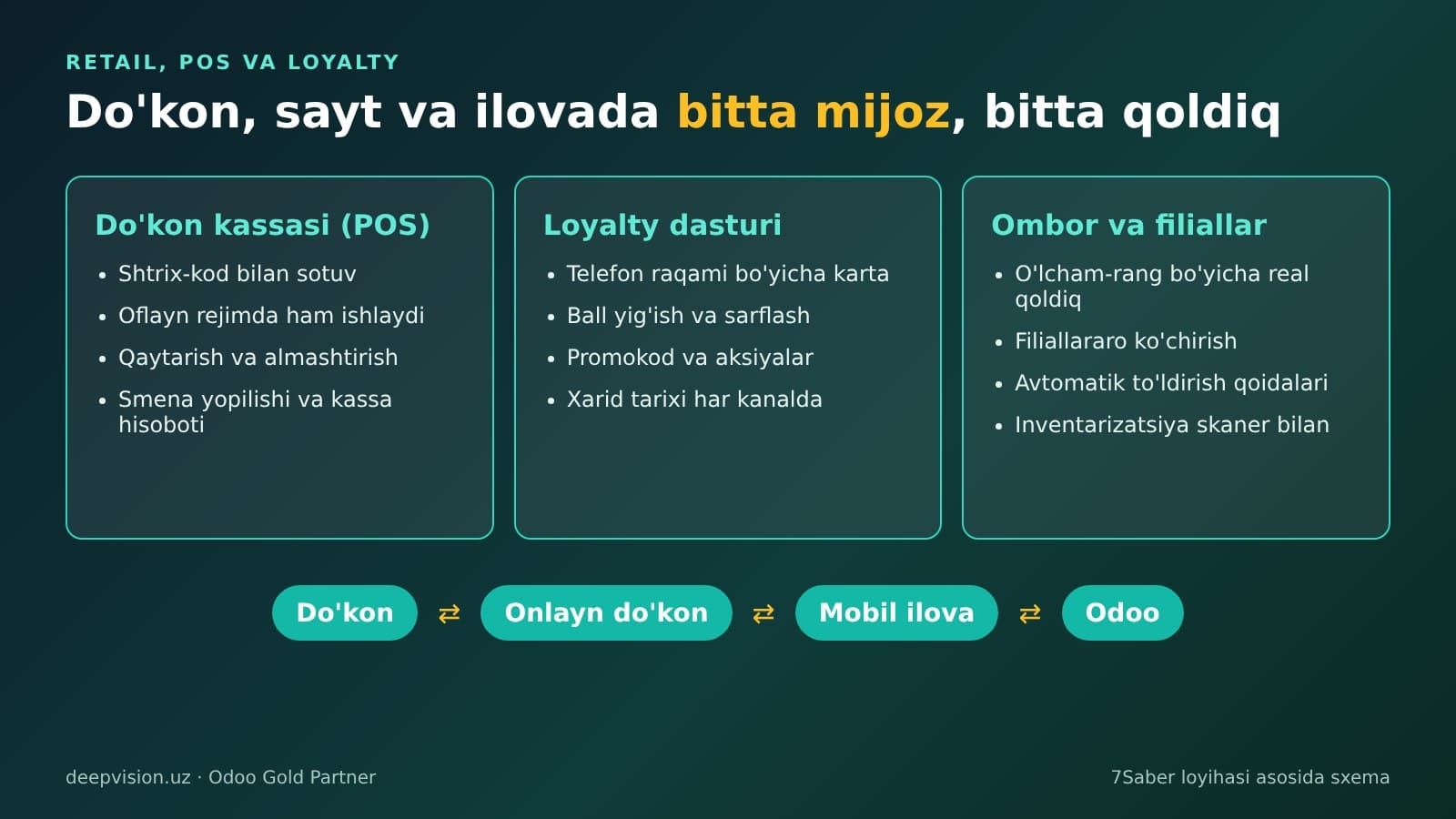
Short answer: When a sportswear brand's stores, online store and mobile app don't share one stock count and one customer base, size M runs out in one place while it sits unsold in another, and the customer is a stranger in every channel. In the 7Saber project, Deep Vision installed Odoo POS tills in the stores, set up branch inventory and a loyalty program, and connected them with manufacturing and finance in one system.
This article is part of the 7Saber case series. 7Saber sells men's, women's and kids' sportswear, footwear and accessories through its own stores, its online store and a mobile app. The brand makes kits for Uzbekistan's Olympic team and national football team, so fan demand spikes on big event days.

The main retail problems of a sports brand
- Stock differs everywhere. The store says "sold out", the website says "in stock", and the warehouse gives a third number.
- Customers get lost between channels. A shopper who bought in a store looks like a new customer online.
- Promotions run by hand. Discounts and promo codes are explained to each store separately, and mistakes happen.
- Till and cash control. When cash in the drawer doesn't match the report at the end of a shift, the cause is hard to find.
- Demand peaks. Before a national-team match or a holiday, one store empties out while another sits on stock.
How is the Odoo solution built?
Store till: Odoo POS
Every store runs Odoo POS. The cashier sells by barcode, and the item lands on the receipt with its size and color. Returns and exchanges link back to the original receipt. If the internet drops, POS keeps working offline and syncs when the connection returns. When a shift closes, a report by cash, card and other payment types is produced automatically.
Branch inventory and transfers
Each store is its own stock location in Odoo. Stock falls the moment a sale is made. If size M is gone in one store and plentiful in another, a transfer takes a few clicks. Minimum-stock rules plan store replenishment from the central warehouse.
One stock count with the online store and app
Orders from the online store and mobile app rely on Odoo stock (through an integration or Odoo eCommerce). The size a customer sees online is actually there.
Loyalty program
The customer is identified by phone number. Each purchase earns points to spend on the next one. Odoo sets up loyalty cards, promo codes, "third item discounted" deals, gift cards and coupons in one place, and they work the same way in every store. A customer's in-store and online purchases collect on one card.
What reports does the system provide?
- Store ranking: revenue, number of receipts, average ticket, sales by hour.
- Sell-through speed and days of stock by size and color.
- Running-low and overstocked variants, with transfer suggestions.
- Loyalty customer share, repeat-purchase frequency, average-ticket difference.
- Promotion and promo-code performance.
- Shift reports and variances by cashier.

Impact on growth: hypotheses
Important: these are not measured 7Saber results. They are Deep Vision's hypotheses about what Odoo usually opens up for sportswear retail chains.
Fewer "we had it but didn't sell it" moments. IHL Group estimates global retail lost about $1.77 trillion in 2023 to out-of-stocks and overstocks (Retail TouchPoints). When real stock across branches is visible and goods move in time, fans find their size and the brand doesn't hand the sale to someone else.
Customers come back. Bain & Company's estimate, cited by HBR, is that a 5% rise in customer retention can raise profits by 25–95% (HBR). Points and personal offers drive repeat purchases, and purchase history makes marketing precise: a customer who bought running gear hears about the new sneakers.
Getting the most from big events. A demand forecast before a national-team match and early distribution to stores help capture the biggest jersey-selling days.
New stores open fast. The till, stock location and prices for a new branch are set up from a template in a few days, which makes expanding across cities and countries cheaper.
Till discipline. Every receipt, discount and return shows who made it, which reduces losses and abuse.
Who is this useful for?
Clothing, footwear and sporting-goods chains, especially brands with their own production. On keeping order as branches multiply: scaling a growing business. A general guide to choosing store software: software for a store.
Frequently asked questions
Does Odoo POS work without internet?
Yes. Odoo POS keeps selling offline and sends data to the server when the connection returns.
Are loyalty points shared between stores and online?
Yes. If the online channel is connected to Odoo, all of a customer's purchases collect on one card.
How is stock moved from one store to another?
Odoo creates an internal transfer: the sending store's stock drops, and the receiving store's stock rises when it accepts the goods.
Sources
- Deep Vision, Odoo partner page (7Saber reference)
- 7Saber online store
- IHL Group study, Retail TouchPoints
- HBR: The Value of Keeping the Right Customers
To connect your stores into one system: leave a request or call +998 77 093 00 07.