


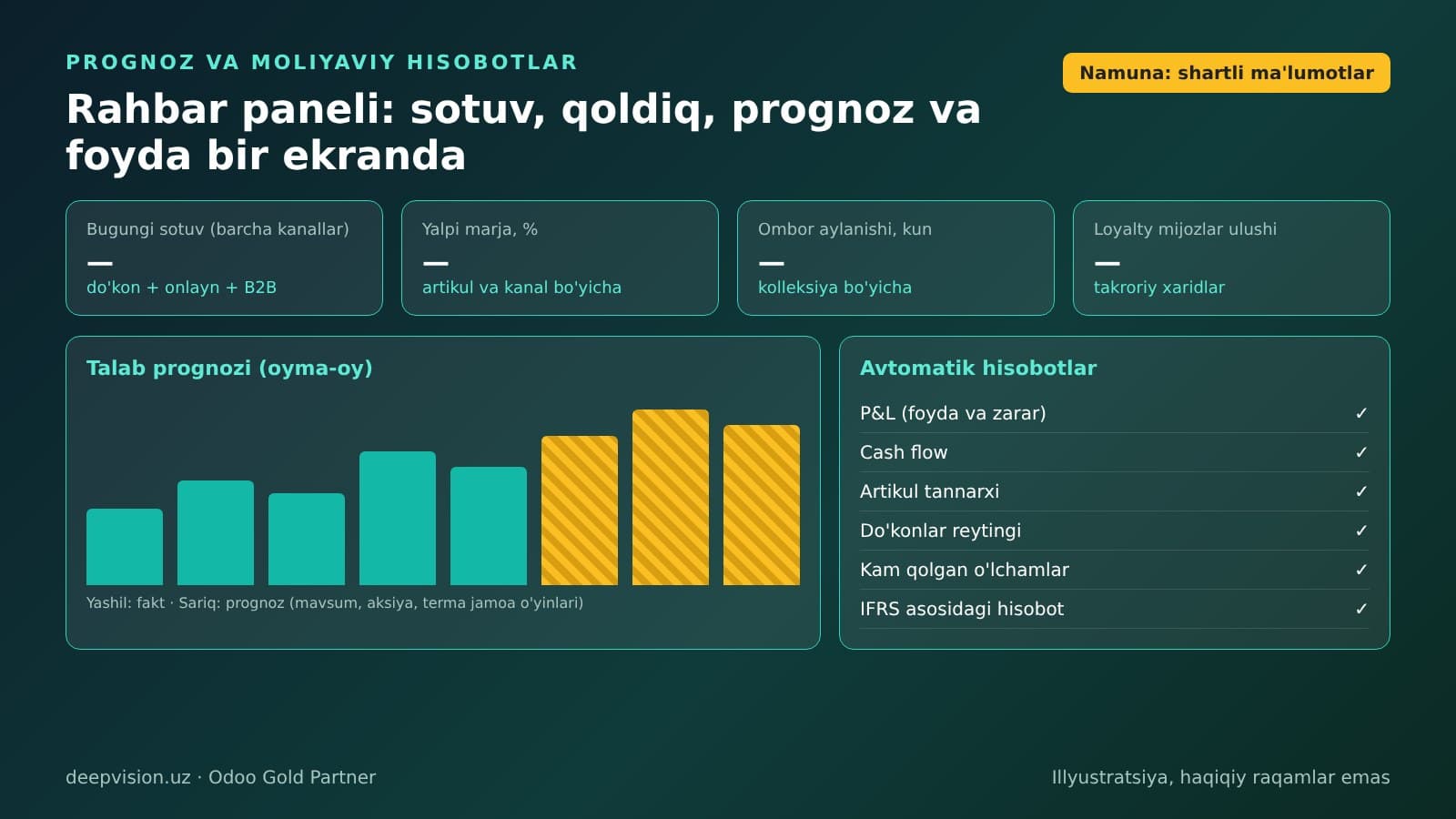
Short answer: The most expensive mistake a sports brand can make is a wrong forecast: an oversized collection freezes cash in the warehouse, and an undersized one sells out on the biggest sales day. In the 7Saber project, Deep Vision set up demand forecasting from sales history and automatic financial reporting in Odoo. This article looks at which reports and forecasts can help a brand grow.
This article closes the 7Saber case series. 7Saber is the sports brand that makes kits for Uzbekistan's Olympic team and its national football team, which qualified for the 2026 FIFA World Cup (UzDaily). Demand at a brand like this swings with the season, the tournament calendar and the team's results, so forecasting and financial transparency are the base for growth.

Why does a sports brand need forecasting?
The apparel production cycle is long: weeks, sometimes months, pass between ordering fabric and reaching the store shelf. The kit being sewn today is meant for demand several months out. Without a forecast, a brand makes two kinds of mistakes:
- Overproduction. The season ends, stock remains, it sells at a discount, and margin disappears.
- Underproduction. The national team wins, fans want the jersey, and the right sizes are gone.
How does forecasting work in Odoo?
Sales history and seasonality
Odoo keeps the full sales history of stores, the online channel and wholesale in one database. That history shows average sell-through and seasonal swings by model, size and channel.
Replenishment plan
The replenishment screen in Odoo Inventory looks at expected demand, current stock and lead times, and suggests when and how much to produce or buy. The Master Production Schedule (MPS) lets the team plan week by week.
Accounting for events
A tournament, the Olympics, the school season or a big promotion goes into the plan as extra demand. In Odoo that means entering an additional quantity in the plan table.
AI assistance
Deep Vision connects Odoo AI for almost all of its clients: financial analysis, forecasting, and analysis of sales and sales calls. The owner can ask a question in a chat on their phone, such as "which model had the best margin last month?", and get an answer. More: AI and ERP.
What financial reports are set up for management?
Deep Vision sets up IFRS-based reporting for all its Odoo clients and adapts it to national reporting requirements. A typical set for a sports brand:
- P&L by company, channel (stores, online, B2B) and collection.
- Cash flow: where money comes from and goes, plus a cash-flow plan for the coming months.
- Item margin: selling price, actual cost and profit after discounts.
- Inventory turnover: how many days stock takes to sell, by collection and model.
- Store profitability: revenue against rent, staff and other costs.
- Receivables and payables: by wholesale customer and supplier.
- Budget vs. actual: the gap between plan and result.
On setting up finance correctly: an Odoo partner that understands finance.

Impact on growth: hypotheses
Important: these are not measured 7Saber results. They are Deep Vision's hypotheses about what forecasting and reporting usually give brands like this, plus figures from global research.
Fewer forecasting errors. McKinsey estimates AI-driven forecasting can cut supply-chain errors by 20–50% and lost sales from unavailable products by up to 65% (McKinsey). For a sports brand, that means fewer "the fan jerseys are sold out" moments and fewer discounted leftovers at season's end.
Unprofitable models show up early. The item-margin report may reveal that some popular models actually earn the least. The price or the BOM changes, and the collection becomes more profitable.
Cash flow is planned. Before a big tournament, the brand sees in advance how much cash raw materials will need and when it will come back. Conversations with a bank or investor are based on numbers.
Trust from investors and partners. IFRS-based reporting makes it easier to work with international distributors, investors and sponsors, which matters for a brand going abroad.
The owner gets time back. Instead of assembling reports, the owner looks at a ready dashboard and works on strategy.
Illustrative example: if a brand holds 10 billion soums of stock a year and a sharper forecast cuts it by just 10%, 1 billion soums returns to working capital. These numbers only show the logic of the calculation; they are not 7Saber data.
Frequently asked questions
Does Odoo have demand forecasting?
Yes. The replenishment plan in Odoo Inventory and the Master Production Schedule (MPS) build plans from sales history and stock. Odoo AI deepens the analysis.
Will the reports follow IFRS?
Deep Vision sets up IFRS-based reporting for all its Odoo clients and adapts it to national reporting.
Can the owner see reports on a phone?
Yes. Odoo runs on mobile devices, and with Odoo AI the owner can type a question in chat and get the answer as a report.
Sources
- Deep Vision, Odoo partner page (7Saber reference)
- UzDaily: national team in 7Saber kits
- McKinsey: Succeeding in the AI supply-chain revolution
To set up forecasting and reporting for your brand: leave a request or call +998 77 093 00 07.