


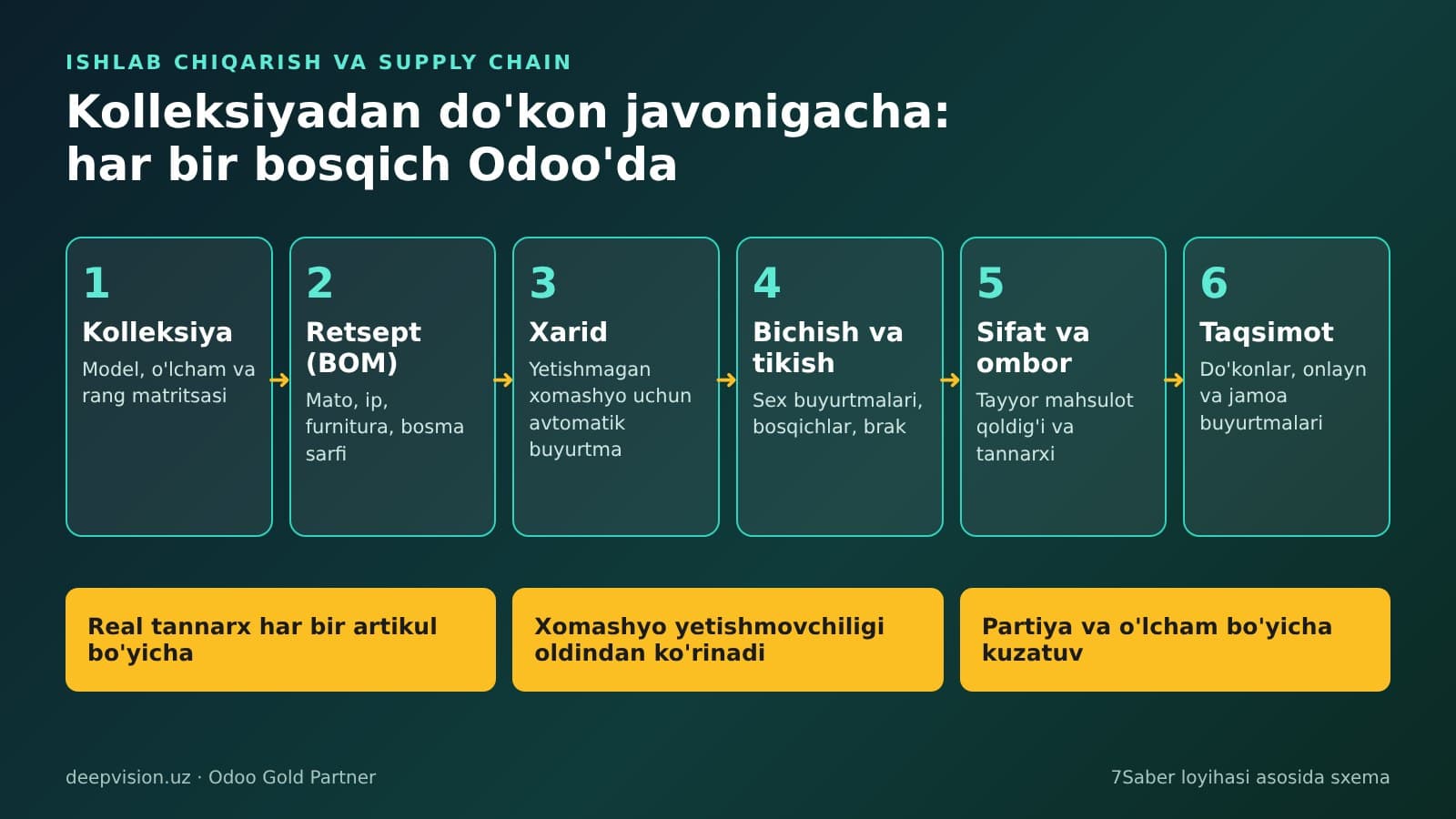
Short answer: The hard part of sportswear manufacturing is dozens of size and color variants inside one model, different fabric use for each, and raw materials arriving on time. In the 7Saber project, Deep Vision linked collections, bills of materials (BOM), manufacturing orders, purchasing and stock into one chain in Odoo. As a result, the cost of every item and the raw-material need are visible in advance.
This article is part of the 7Saber case series. 7Saber is the sports brand that makes kits for Uzbekistan's Olympic team and its national football team. Here we look in detail at the manufacturing and supply-chain side of the project.

What makes sportswear manufacturing different?
A trading company buys finished goods and resells them. A sports brand creates its products, so its bookkeeping is twice as complex:
- Many variants. One kit model comes in 6–8 sizes and several colors. Each is a separate stock line.
- Consumption depends on size. An XL uses more fabric than an S. One BOM for all sizes gives the wrong cost.
- Materials travel far. Technical fabrics and trims are often imported, and delivery takes weeks.
- Two kinds of orders. Batch production for stores, and custom team orders with names, numbers and printed logos.
- Seasons and events. Demand spikes before the Olympics, a championship or the school season.
How is the chain built in Odoo?
1. Collection and variants
Each model is a product template in Odoo, with size and color as attributes. The system generates the variants and gives each its own barcode. More on this matrix for apparel brands: size-color matrix and collections.
2. Bill of materials (BOM)
The BOM lists how much fabric, thread, elastic, zippers, labels and printing one garment needs. In Odoo, BOM lines can apply to specific variants, so fabric use for XL is set separately from S. That makes the cost correct for every variant.
3. Purchasing and automatic replenishment
Each raw material gets a minimum-stock rule. When stock drops below it, or a new manufacturing order creates a shortage, Odoo drafts the purchase order itself. Supplier, price and lead time are stored in the system, so the order goes out before the material is needed.
For imported materials, freight, customs and exchange differences are added to cost. That is a topic of its own: the true landed cost of imported goods.
4. Manufacturing orders: cutting, sewing, printing
A manufacturing order is split across work centers: cutting, sewing, printing or embroidery, pressing and packing. Each step records start and finish time, the person responsible, and defects. The manager sees on screen which order is at which step.
5. Quality control and finished goods
A finished batch is checked before it enters the warehouse. Defects are tracked separately with a reason. Every unit enters stock with its cost.
6. Distribution
Finished goods go to stores, the online-store warehouse and team orders. On store stock and tills: stores, POS and loyalty.
Team orders: make to order
When a club or federation orders 40 kits, each carries a player's name and number. In Odoo this order follows the make-to-order route: once the sales order is confirmed, a linked manufacturing order and, if needed, a purchase order open automatically. The account manager can tell the client exactly which step the order is at.
What reports does the system provide?
- Planned and actual cost of every item and variant.
- Raw-material use per BOM versus actual, with reasons for variance.
- Work-center load and late orders.
- Defect rate by step and reason.
- Expected material receipts and shortage forecast.
- Supplier reliability on lead times and prices.

Business impact: hypotheses
Important: these are not measured 7Saber results. They are Deep Vision's hypotheses about what Odoo usually offers manufacturers of this type.
Cost becomes visible. Many brands work with an average cost and do not know which model actually loses money. Variant-level cost lets the brand revisit pricing: some models get a price increase, others leave the collection. A margin gain of a few percentage points changes annual profit noticeably.
The workshop does not stand idle. When a material shortage shows early, the line is not left "waiting for fabric". Before a major tournament, that means hitting deadlines and protecting the brand's reputation.
Less raw-material stock. Instead of a big "just in case" stock, purchasing follows the BOM and the plan. Freed-up cash goes into the next collection or marketing.
Faster team orders. An automatic chain from order to production lets the brand grow B2B sales: clubs, schools, corporate uniforms.
Scale. A new production site or an external sewing shop joins the system as a new work center or subcontractor.
Who is this useful for?
Sewing workshops, knitwear, footwear and sports-equipment manufacturers. A separate article on knitwear: yarn use, defects and shifts.
Frequently asked questions
Can Odoo record fabric use separately for each size?
Yes. BOM lines can be tied to specific variants, so consumption is set per size.
Does Odoo order raw materials by itself?
Odoo drafts purchase orders from minimum-stock rules and the production plan. Whether they are approved manually or sent automatically depends on company rules.
Is work with external sewing shops tracked?
Yes. Odoo supports subcontracted manufacturing: materials go to the external shop and finished goods are booked when they come back.
Sources
- Deep Vision, Odoo partner page (7Saber reference)
- UzDaily: national team in 7Saber kits
- Odoo Manufacturing documentation
To see your production in Odoo: leave a request or call +998 77 093 00 07.