


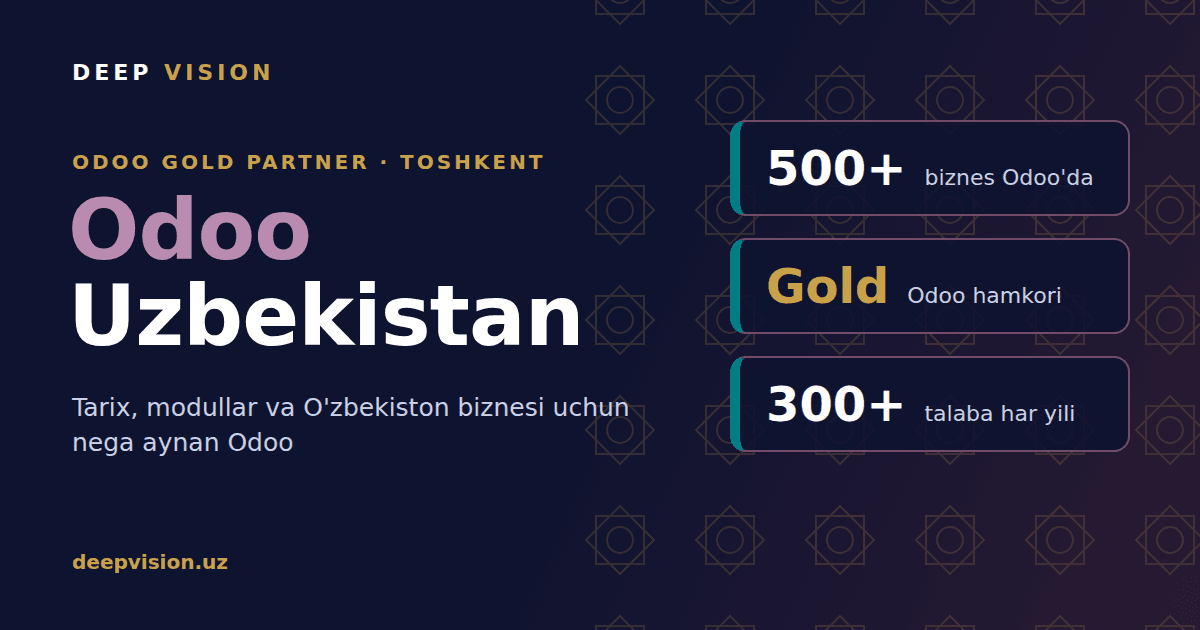
Short answer: Odoo Uzbekistan is the local ecosystem around the Odoo ERP: accounting and tax set up for Uzbek law, integrations with e-invoicing and product marking, official partners, training programs and events run by Odoo itself. Market participants estimate that more than 500 businesses in Uzbekistan now use Odoo, making it one of the most popular ERP systems in the region. Deep Vision is an official Odoo Gold Partner in Tashkent.
A few years ago, "ERP" in Uzbekistan meant 1C or a stack of Excel files for most companies. Sales lived in one program, the warehouse in another file, accounting somewhere else, and the owner waited for a weekly report. That has changed. Trading, manufacturing, distribution and service companies now want to run everything in one system, and Odoo is at the center of that shift. This article covers how Odoo came to Uzbekistan, why it is the most convenient ERP for local businesses, which modules are used most, and how the community around it is being built.
What is Odoo and how widely is it used?
Odoo is a modular ERP system from Belgium that brings sales, CRM, inventory, purchasing, accounting, manufacturing, HR and the website together in one database.
Odoo started in 2005 as TinyERP, created by Fabien Pinckaers. It was renamed OpenERP in 2008 and Odoo in 2014. There are two editions: the free, open-source Community edition and the paid Enterprise edition with extra features (we compare them in Odoo Community vs Enterprise). According to Odoo's official website, more than 12 million users work with Odoo, and its partner network covers more than a hundred countries.
The idea behind Odoo is simple: instead of buying a separate program for every department, you plug the modules you need into one system. Start with CRM and sales today, add inventory tomorrow, then accounting and manufacturing, while all data stays in one place. For the basics, read What is Odoo ERP?.
How did Odoo develop in Uzbekistan?
Odoo's path in Uzbekistan went through several stages.
- The enthusiast years. At first, Odoo (then OpenERP) was known mostly to developers and IT enthusiasts. Thanks to open source it could be installed for free, but there were almost no solutions adapted to local accounting standards, the sum currency or tax rules. 1C dominated the market.
- Digitalization reforms. The government then pushed hard on digitalizing business: e-invoices became mandatory, and online cash registers, Asl Belgisi digital product marking and the Tax Committee's e-services arrived. Companies realized the old "paper plus Excel" approach could not keep up, and demand grew for a modern ERP open to integrations.
- Professional partners arrived. Official Odoo partners started working in Uzbekistan. They localized the system for Uzbek and Russian, the national chart of accounts, VAT and local document forms, and built integrations with Didox, Soliq, Payme, Click and Telegram. This is when Odoo turned from "foreign software" into a system that works for Uzbek businesses.
- Mainstream adoption. Today Odoo runs in wholesale and retail, distribution, manufacturing, HoReCa, construction and services. Market participants estimate that more than 500 businesses in Uzbekistan already use Odoo, and the number grows every year.
A clear sign of this growth is that Odoo itself is paying serious attention to Uzbekistan. More on that below.
Why has Odoo become one of the most popular ERPs in the region?
Companies in Central Asia choosing an ERP face a gap: large international systems (SAP, Oracle) are expensive and slow to implement, while older local tools are not ready for modern integrations and mobile work. Odoo filled that gap.
- Price that scales. A small business starts with a few modules and the system grows with the company. There is no large upfront license. See budget ranges in Odoo ERP pricing in Uzbekistan.
- One system, one database. Sales managers, warehouse staff, accountants and the owner see the same data. Arguments about "whose number is right" disappear.
- Fast implementation. Standard sales and inventory modules usually go live in 6–8 weeks; more complex projects take 2–6 months.
- Modern interface. Odoo runs in the browser and on mobile, and staff learn it quickly. That matters for young teams.
- Open ecosystem. Thousands of ready-made apps exist worldwide, plus modules built by local partners. Almost any process can be extended.
Why is Odoo the most convenient ERP for businesses in Uzbekistan?
We consider Odoo the most convenient ERP for the Uzbek market, and the reasons are concrete and easy to check.
- Fits local regulation. Odoo can be configured with the national chart of accounts, 12% VAT, accounting in sum with exchange rates, and local invoice forms. More in Odoo adapted to Uzbek tax and VAT.
- Integration with government systems. Deep Vision has ready-made Odoo modules for Asl Belgisi digital marking and Didox e-document exchange, so marking codes and e-invoices are handled directly from Odoo. See Asl Belgisi: digital product marking in Uzbekistan and E-invoicing in Uzbekistan: Didox, Soliq and ERP integration.
- Local payments and channels. Payme, Click, bank statements, Telegram bots and IP telephony can all be connected. An order a customer sends on Telegram lands in the CRM automatically.
- Three languages. The interface works in Uzbek, Russian and English, so teams that speak different languages share one system.
- A clear path from 1C. Many companies come from 1C, and there is solid experience moving products, counterparties, stock balances and open debts: Migrating from 1C to Odoo.
- A growing talent pool. University courses and community events make it easier every year to hire developers and users who know Odoo, which lowers the long-term support risk.
Odoo modules and how they fit businesses in Uzbekistan
Odoo modules are separately installed apps that share one database; each module runs one area of the business.
Here are the modules used most in Uzbekistan and how companies apply them. The full list is in Odoo ERP modules.
- CRM: collects leads from Telegram, Instagram, the website and calls into one pipeline. Managers see each client's full history; the owner tracks conversion.
- Sales: quotations, contracts, discounts and price lists. Wholesalers can easily keep different prices and payment terms for different customers.
- Inventory: multiple warehouses, lots and serial numbers, barcodes and real-time stock. Especially useful for distributors with thousands of SKUs (Timsoll manages more than 7,000 SKUs in Odoo).
- Purchase: supplier orders, automatic reorder suggestions from minimum stock, and landed costs spread onto product cost for imports.
- Accounting: national chart of accounts, VAT, bank statement import, receivables and payables, management reports.
- Manufacturing: bills of materials, production orders, raw material consumption and costing. Common in food production, building materials and light industry.
- POS: point of sale for shops and restaurants, linked instantly to inventory and accounting.
- HR and payroll: employee records, attendance, time off and KPIs.
- Website and e-commerce: an online store that works directly with live stock and prices.
You do not need to install everything at once. Most of our clients start with CRM, Sales and Inventory, then add Accounting and Manufacturing.
Deep Vision: Odoo Gold Partner in Uzbekistan
Deep Vision is an official Odoo Gold Partner based in Tashkent. Odoo awards Gold status based on the number of certified specialists, delivered projects and customer satisfaction. Our team handles Odoo implementation, customization, integrations, data migration, training and support. We explain why clients choose us in Why DeepVision.
For us, Odoo is more than a product to sell. A strong Odoo ecosystem in Uzbekistan benefits every client: specialists are easier to find, there are more ready-made solutions, and trust in the system grows. That is why we invest time and resources in the community.
How we are growing the Odoo community
- 4 hackathons. We have run 4 hackathons where developers and students solved real business problems on Odoo and built working modules in a short time.
- 3 seminars. We organized 3 seminars for entrepreneurs and executives on business digitalization and what Odoo can do.
- Online course. We built an online course for people who want to learn Odoo on their own.
- Teaching at 3 universities. Odoo is taught at 3 universities, and more than 300 students get hands-on ERP experience every year. This is how a new generation of ERP specialists is being trained in Uzbekistan.
How serious is Odoo about Uzbekistan?
Odoo sees Uzbekistan as a promising market and is investing in it. There are visible signs.
- Official events in Tashkent. Odoo holds its own events in Tashkent; Odoo Roadshow and Business Show meetups have been announced on odoo.com. Odoo now comes to Uzbekistan up to 3 times a year and hosts events at the Hilton, one of the most prestigious hotels in the capital, where entrepreneurs, partners and the Odoo team meet face to face.
- A "Tashkent" room in Dubai. Odoo's Dubai office has a meeting room named "Tashkent" as a symbolic gesture of respect. It is a small detail, but it shows how Odoo views markets in the region, including Uzbekistan.
- A growing partner network. The number of official Odoo partners in Uzbekistan keeps rising, which gives clients more choice and more competition on quality. How to choose one: How to choose an Odoo partner in Uzbekistan.
What does this mean for a business owner? Behind the system you choose stands a global company with long-term plans for the region, plus a local ecosystem. That is one of the most important factors in choosing an ERP: the system needs to keep evolving and be supported 5–10 years from now.
How does an Odoo implementation start?
An Odoo project usually goes through these stages:
- Analysis. We study your processes, document flow and bottlenecks and decide which modules you need.
- Project plan and budget. Modules, integrations, migration scope and timelines are agreed. More in How much does Odoo implementation cost?
- Configuration and customization. The system is set up for your processes, with extra modules built where needed.
- Data migration. Products, customers and stock balances are moved from 1C, Excel or another system.
- Training and go-live. Staff are trained and the system goes live in stages.
- Support. Questions, new requirements and ongoing development after launch.
For a real example, read Timsoll's experience with Odoo.
Frequently asked questions
How many companies use Odoo in Uzbekistan?
Market participants estimate that more than 500 businesses in Uzbekistan use Odoo. There are no official government statistics, but the number grows every year.
Does Odoo comply with Uzbek tax law?
Yes, when configured correctly. The national chart of accounts, 12% VAT, accounting in sum and local document forms are all set up. Deep Vision has ready-made integration modules for e-invoicing and product marking.
Does Odoo work with Didox and Asl Belgisi?
Yes. Deep Vision's ready-made Odoo modules let you manage e-invoices through Didox and Asl Belgisi marking codes directly from Odoo.
Is Odoo available in Uzbek?
Yes. The interface works in Uzbek, Russian and English, and each user can pick their own language.
What does Odoo Gold Partner mean?
It is an official partnership level that Odoo awards based on certified specialists, delivered projects and customer satisfaction. Deep Vision is an Odoo Gold Partner in Uzbekistan.
How long does an Odoo implementation take?
Standard sales and inventory modules usually go live in 6–8 weeks. Projects with several modules and integrations take 2–6 months.
Where can I learn Odoo?
Through Deep Vision's online course, seminars and hackathons, and through university courses where Odoo is taught. Client staff are trained as part of every implementation.
Is Odoo better than 1C?
It depends on your business. Odoo combines CRM, sales, inventory and accounting in one system, runs in the browser and is open to integrations. Full comparison: Odoo vs 1C.
Bring your business into one system with Odoo
If your business is still split across several programs and Excel files, Odoo brings it all into one clear system. The Deep Vision team will review your processes and tell you which modules to start with and what budget to plan. Book a free consultation or call +998 77 093 00 07. More about Odoo: Odoo ERP in Uzbekistan.